

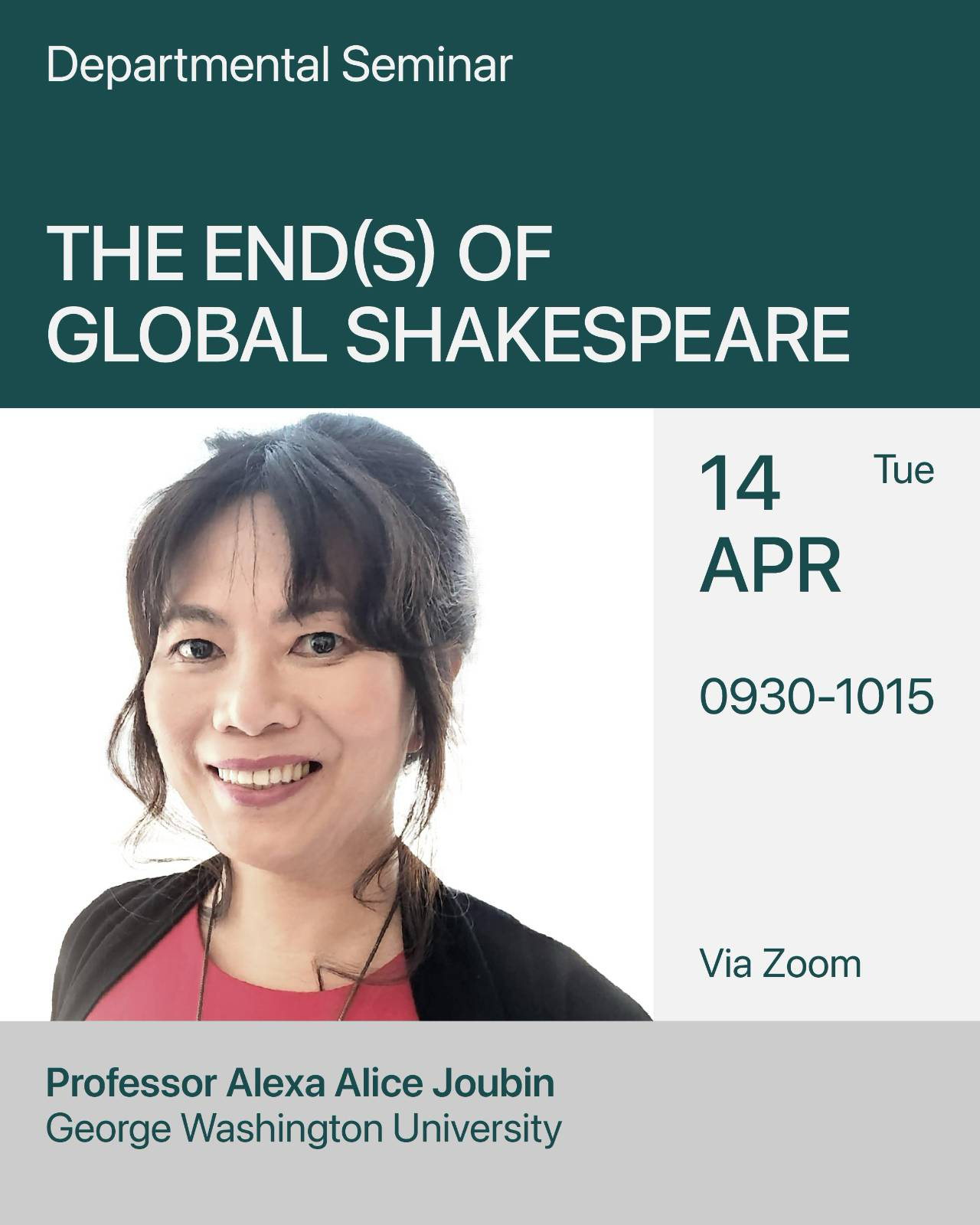
What are the ends of global Shakespeare as a field of study? In the past three decades, global Shakespeare has expanded Shakespeare studies’ Anglo-centric outlook. We now need new methods to theorize performances of Shakespeare across cultures.
This presentation suggests heterotopia as a new method to analyze diverse and polyphonic performances. In Michel Foucault’s theory of heterotopia, the notion describes worlds within worlds. Joubin builds upon Foucault’s architectural metaphor to theorize cultural spaces that are transformative because of their contradictory or trans-historical ideologies. Heterotopia, as a parallel space that contains and evokes other spaces, exists in reality (such as a theatre stage) and holds up a mirror to other realities.
This presentation argues that global Shakespeare operates as a heterotopia. Performances connect audiences with fictional worlds in a different time and place. They also evoke other parts of audiences’ contemporary worlds. Heterotopia, or worlds within worlds, captures the vitality and viability of global performances of Shakespeare.
An example of global Shakespeare as heterotopia is Yukio Ninagawa’s high-concept production of Hamlet (1998 and 2015), which turns the art of theatre-making inside out through its metatheatrical conceit. The production opens with actor-characters warming up, running their lines and touching up on their makeup. They mill around on a set that represents the backstage of a theatre where the actor-characters both prepare for and stage Hamlet. The two-story set consists of dressing rooms with privacy curtains, complete with lighted mirrors, photographs, and bouquets. The lower level is a common dressing area for everyone, while the upper level is reserved for leading actor-characters’ individual dressing rooms. This backstage space is now upstage. This set doubles as rooms in Elsinore Castle once the story of Hamlet begins.
Heterotopia pushes back against the illusions of Shakespeare’s universal meanings by pluralizing the aesthetic and political positions across and within artistic, scholarly and pedagogical communities. Global performances of Shakespeare create worlds within worlds by combining the plays and audiences’ senses of place to build cultural spaces that are transformative. Heterotopia, created by the craft of world-making, anchors, enables and endorses some characters’ transformative experiences and self-discovery.
This seminar is part of the Hong Kong International Shakespeare Conference 2026. Following the seminar, there will be a book launch titled “Shakespearean Studies: New Books in the Field” by Prof. Alexa Alice Joubin and Dr. Miriam Lau. The launch will be moderated by Prof. Michael Dobson, Director of The Shakespeare Institute at the University of Birmingham. Details are available on the conference website.
The seminar and book launch will be accessible via the same Zoom link provided below.
About the Speaker
Alexa Alice Joubin is Professor of English, Women’s, Gender and Sexuality Studies, Theatre, International Affairs, and East Asian Languages and Literatures at George Washington University in Washington, D.C., where she directs the Digital Humanities Institute. The inaugural recipient of the bell hooks Legacy Award, she held the Fulbright Distinguished Chair at Queen Mary University of London and the University of Warwick in the UK. In 2026, she received the Shakespeare Association of America’s Barbara Hodgdon Award as well as honorable mention for the Publics Award.
Departmental Seminar: The End(s) of Global Shakespeare
By Prof. Alexa Alice Joubin, George Washington University
Date: Tuesday 14 April 2026
Time: 9:30am – 10:15am
Moderator: Prof. Min-hua Wu, Associate Professor, Department of English, National Chengchi University
Venue: Via Zoom
Viewing Link (for both the seminar and book talk): https://mit.zoom.us/j/94864155318
Meeting ID: 948 6415 5318